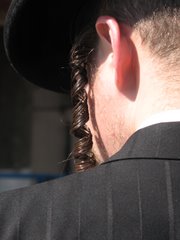
I am fascinated by the appearance of certain Chasidic men, the ones with full beards, peyes (the long and curled sideburns) and streimels (wide fur hats). Some also wear knickers, white socks and, on holidays, striped or black silk coats with sashes that resemble heavily tailored smoking jackets. In other words, they are dressed like Polish nobility from the 19th century.
Their look is compelling, yet it is a major No-No to be obvious about photographing them*. So, on the last day of Passover I was trying to be very sly as I tried to photograph some of these people as they walked to the Kotel (photography at the Western Wall, on holy days, is strictly forbidden). I found a place to sit near the steps leading to the Wall and positioned my camera, ready to snap as soon as someone interesting came along.
The problem, for me, was that these men, despite wearing bulky clothing and enormous hats, are FAST, faster than my camera! These are nimble guys, accustomed to leaping onto moving Israeli buses in a single bound, with either a prayerbook or children in hand. They also seem to have a sensor that lets them know when someone is taking an interest in them, and at that moment they accelerate. My digital camera, for all its miraculous features, has a distinct shutter lag. Although it's just a fraction of a second, it feels like an eternity compared to the speed of my SLR (at home!), and so I've often missed my subjects.
Frustrated, I left the Jewish Quarter to check out the Arab Market and then head home. As I exited the Olid City I noticed that many Chasidic Jews were heading home. I followed them, to a point, and found a spot where I could observe the community's comings and goings rather unobtrusively. With my camera zoomed, I started shooting again. After awhile I started to feel more sneaky than satisfied and decided to leave these swift moving people alone.
*I went on a guided tour of their neighborhood, Meah She'arim, and although the group was respectfully dressed, with cameras packed away, many of the youth there cursed at us and told us to leave. Apparently the extremists among them have been known to pelt visitors with nasty things!
Showing posts with label Religion. Show all posts
Showing posts with label Religion. Show all posts
Wednesday, April 11, 2007


Via Strollerosa
On Good Friday, devout Christians (and tourists*, and the paparazzi), create a procession or pilgrimage through the Via Dolorosa, following the path that Christ walked on the way to his crucifixion and ending at the Church of the Holy Sepulchre. But you probably knew that.
What you might not have realized is that on Jewish festivals and holy days, pious Jews have to contend with the Via Strollerosa in order to reach the Kotel (the Western Wall). One can't just meander up to the Kotel and begin to pray. There are security gates, with soldiers and guards and metal detectors. But even before that, there are steps, many steps, especially if one is approaching the Kotel from the Jewish Quarter of the Old City. And remember, these people have already walked a substantial distance from their homes to reach the Old City and will return on foot.
On the last day of Passover, religious Jews of all sartorial persuasions (some in stripes, most in solids; a group of black hatted young men wore wide, bright pink neckties, not a typical sight!) were hurrying to the Kotel. Entire families came, many with a stroller seating one or two young children. If the family was of average size (say, four kids), a parent and the older siblings (who might be just four or five) would lift the stroller up and hand carry it all the way down the many, many steps, much as courtiers would have transported a king or queen. There were also unaccompanied moms or dads, perhaps catching up with the rest of their families. Some of them bumpity-bumped and banged the stroller all the way down the stairs, giving their babies a joint jangling ride.
I didn't stick around long enough to watch them make the return schlep up all the steps of Via Strollerosa.
*I was amongst the hordes who, inadvertently, became part of the Good Friday pilgrimage. To be posted at a future date.
Sunday, March 11, 2007
The Message of the Mechitza
A "mechitza" is a divider that separates the women from the men in Orthodox synagogues. How the separation is accomplished varies by synagogue and says something about how the congregation interacts with their female members.
Example A: Up and Away
Many older shuls (synagogues) were designed with balconies, so that women would sit overlooking the main sanctuary, containing the ark, the bimah (pulpit of sorts) and the men's seating area. While completely removed from the scene of the "action", the leading of prayers and the reading of the Torah, in this variation at least the women can see what is going on.
Example B: On (almost) the Same Plane
In some contemporary Orthodox shuls, the mechitza divides the central sanctuary, with women and men seated on either side, on the same plane. The height and material of the mechitza can range from a low permanent wooden barrier to a tall portable screen, or many variations in between. This version is a bit friendlier than Example A, although women are still not involved in reading the Torah.
Example C: Separate but Equal
I'm told that there is a synagogue in Jerusalem where the mechitza runs smack down the middle of the sanctuary AND continues through the middle of the bimah, allowing both women and men to read from the Torah without sharing the same physical space.
Example D: Out of Sight, Out of Earshot
And there is the "we don't want to see or hear you" mechitza, behind which I found myself on a recent Erev Shabbat. The mechitza itself was made of lace but the women's section was a small area behind the sanctuary, near one of the restrooms. Through the lace I could see the backs of heads but the height of the divider obstructed my view of the stained glass and colorful quilted curtain on the ark. Frustrated by my position at the rear, I sang my favorite Shabbat melodies as passionately as I could, which I really wasn't supposed to in this particular place. One of the handful of women in my section was, I think, trying to shush me. It didn't matter - I was quickly and easily drowned out, and I felt left out.
Walking back to the Ulpan from services, another American in my group commented that this synagogue had one of the most aggressive mechitzas (ok, it's really "mechitzot" in Hebrew) he's ever seen.
I certainly received the message that I was a persona non grata. I will not be returning.
Subscribe to:
Posts (Atom)